STATE OF NEW HAMPSHIRE
Conceptual Design Stage — Pending G&C Approval
DoIT
Enterprise Services Lead
DHHS
Program Requirements Lead
Future Program Sponsors (Phases 2-3):
Additional agencies planned for ESB adoption post-DHHS implementation
Statewide Enterprise Service Bus
Implementation Plan
MuleSoft API-Led Connectivity Platform for NH Medicaid Enterprise System Modernization
DHHS Division Program Leadership:
MuleSoft Government Cloud
FedRAMP Moderate
Real-Time Integration
Replace 200+ SFTP
MITA Level 2 → 3.5
Current → Target
30+ APIs
Planned Deployment
Executive Summary
Comprehensive phased implementation plan for deploying a statewide Enterprise Service Bus leveraging MuleSoft Anypoint Platform as the foundation for NH DHHS integration modernization.
DDI Investment
$0.00M
Federal Share (90%)
$0.00M
State Share (10%)
$0.00M
DDI Timeline
0.00 Months
Phases
0 Phases
Target APIs
0+
Operations & Maintenance (Steady-State)
Peak Staffing (Ph 2)
0 FTE
8 State / 20 Contractor
Steady-State (Jan 2028+)
0 FTE
10 State / 7 Contractor
Annual O&M
$0.00M
75% FFP ($2.55M Fed / $0.85M State)
5-Year O&M Total
$0M
Fed: $12.75M / State: $4.25M
Strategic Objectives
- Replace 200+ SFTP integrations with managed APIs
- Enable real-time data exchange across MMIS
- Automate CMS-64, T-MSIS, OCSE-34/157 reporting
- Achieve MITA Level 3.5 by Q4 2031
- Onboard DOT & DOS divisions in Phase 3+
- Establish enterprise API governance framework
Implementation Timeline
22.5-month DDI roadmap (Feb 2026 - Dec 2027) with 6-month incremental milestones aligned to budget cycles
Phase Details
Detailed breakdown of objectives, activities, and success criteria
Phase 0: Foundation
Feb 1 - Jun 15, 2026 (4.5 months)
Objectives
- CMS IAPD approval & G&C contracting
- Deploy MuleSoft Government Cloud (FedRAMP Moderate)
- Establish connectivity to Conduent ORR ecosystem
- Create foundational API endpoints (3-5 System APIs)
- ITSM/ServiceNow foundation setup
Key Activities
- Execute SI procurement process (GraniteBus partner selection)
- Provision MuleSoft Anypoint Platform with Runtime Fabric (RTF)
- Deploy Runtime Fabric agents in NH DHHS data center
- Configure Anypoint MQ for asynchronous messaging
- Build DevOps CI/CD pipeline with automated testing
- Establish ODBC connections to MMIS ORR, NHORR, PBM ORR
- Deploy object stores for report caching (freshness scoring)
- Implement TLS 1.3 encryption and API governance policies
Success Criteria
- CMS IAPD and G&C approvals secured
- SI partner contract executed
- MuleSoft Government Cloud operational with FedRAMP compliance
- 3-5 System APIs deployed with >99% availability
- ServiceNow integration established for incident management
Phase Budget
Total
$1.81M
Federal (90%)
$1.63M
State (10%)
$181K
Staffing
16 FTE (4 State / 12 Contractor)
Investment Analysis
22.5-month DDI (Feb 2026 - Dec 2027) with 6-month incremental milestones aligned to budget cycles
$12.75M
DDI Investment
90% FFP Rate
$17.0M
5-Year M&O
17 FTE (10 State / 7 Cont.)
$29.75M
Total Program
FY2026-2032
$24.23M
Federal Share
81% FFP blended
$5.53M
State Share
19% state match
DDI Phase (90% FFP): $12.75M
Federal (90%)
$11.48M
State (10%)
$1.28M
5-Year M&O (75% FFP): $17.0M
Federal (75%)
$12.75M
State (25%)
$4.25M
DDI Budget by Phase ($M) - 6-Month Increments
Phase 0
$1.81M | 16 FTE
4.5 months
Phase 1
$3.60M | 24 FTE
6 months
Phase 2
$4.20M | 28 FTE
6 mo (Peak)
Phase 3
$3.14M | 22 FTE
6 months
Conservative ROI Analysis (40% Benefit Realization Factor)
6-Year Investment
$29.75M
Was $10.2M
Annual Benefits
$32.2M
Was $88.9M
Benefit-Cost Ratio
3.2:1
Was 18.2:1
Payback Period
3.5 yrs
Was 1.2 yrs
*Even with conservative estimates, program delivers positive ROI with NPV of $48.2M (7% discount rate)
Key Risk Factors Applied to Estimates
+25%
MuleSoft specialists scarce; market premium for architects
+15%
SI partner negotiations; Conduent coordination overhead
+6 mo
CMS IAPD approval; G&C procurement cycles extended
+20%
Legacy ORR complexity; 200+ SFTP connections to migrate
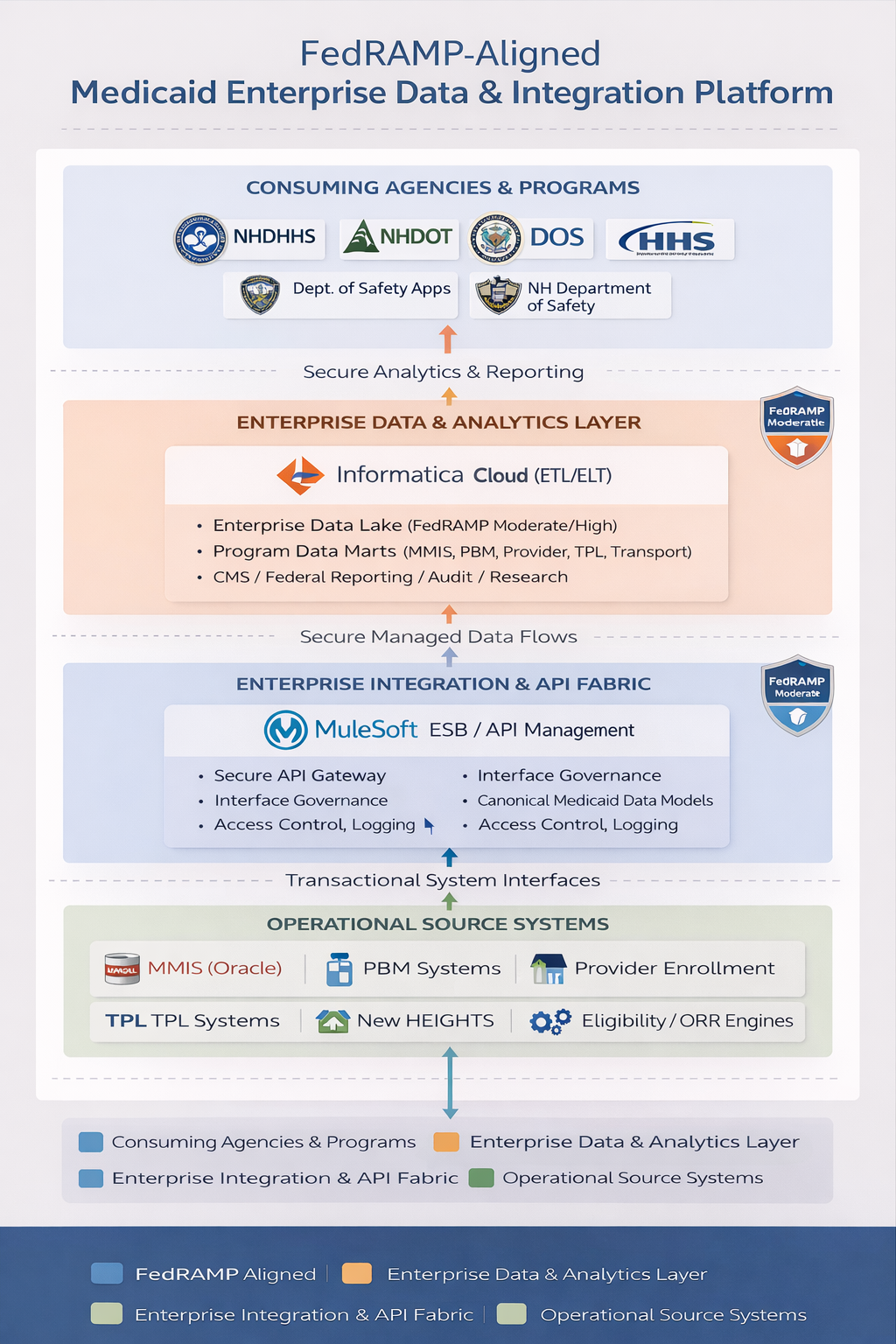
Integration Architecture
NH DHHS Enterprise Integration Architecture Overview
Risk Dashboard
Enterprise-level risk assessment and mitigation strategies
Critical Risk
High Risk
Medium Risk
Low Risk
Technical Risks
Legacy integration complexity
HighMitigation: Detailed discovery POC; maintain SFTP fallback
Integration performance
HighMitigation: Performance testing early; horizontal scaling
Organizational Risks
Staff capacity constraints
MediumMitigation: Hybrid staffing model; phased implementation
Change resistance
MediumMitigation: Training, GraniteBus partnership, change management
Vendor Risks
Conduent data access delays
HighMitigation: Early contractual engagement; escalation path
Vendor lock-in
LowMitigation: Open standards; knowledge transfer
Regulatory Risks
CMS IAPD approval
CriticalMitigation: Early State Officer engagement; pre-submission review
Security accreditation delays
MediumMitigation: Early DoIT security engagement; FedRAMP artifacts
Governance Framework
Enterprise-level governance structure for multi-agency integration
Project Governance Structure
Enterprise Services Planning
Multi-Agency Portfolio Planning Committee
Project Governance Board
DHHS IT Director | DHHS PMO | DoIT Project Lead | GraniteBus | Conduent Liaison
Technical Council
Architecture | Security | Standards
Data Governance
Data Quality | Privacy | Stewardship
Change Advisory
Release Mgmt | Change Control | Risk
API Governance Standards
| Standard | Specification | Enforcement |
|---|---|---|
| API Design | RESTful, OpenAPI 3.0 | API Review Board approval |
| Security | OAuth 2.0, TLS 1.3, AES-256 | Security scan before deployment |
| Performance | <250ms p95, >99.9% availability | Automated monitoring |
| Documentation | RAML 1.0, inline examples | Coverage metrics |
| Versioning | Semantic versioning | Version lifecycle management |
NH DHHS / DoIT | Document Version 1.0 | January 2026
This document was prepared in support of the NH DHHS MMIS Integration Modernization initiative
Staffing Plan
Phased staffing approach from POC through steady-state operations
Phase 0 Team (Feb 1 - Jun 15, 2026)
| Role | FTE | Type | Responsibilities |
|---|---|---|---|
| Program Manager | 1 | State (DHHS) | IAPD/G&C oversight, CMS liaison, stakeholder mgmt |
| Technical Lead / EA | 1 | State (DoIT) | EA standards, API governance, MITA roadmap |
| Senior Business Analyst | 1 | State (DHHS) | Requirements, T-MSIS/CMS-64 mapping |
| Security & Compliance | 1 | State (DoIT) | FedRAMP review, HIPAA compliance, ATO |
| SI Project Manager | 1 | Contractor | SI delivery mgmt, project coordination |
| MuleSoft Solution Architect | 1 | Contractor | Platform architecture, API-led design |
| Senior MuleSoft Developer | 2 | Contractor | System/Process API development |
| MuleSoft Developer | 2 | Contractor | API components, DataWeave transforms |
| Data Integration Engineer | 1 | Contractor | ODBC/ORR connectivity, schema mapping |
| DevOps Engineer | 1 | Contractor | CI/CD pipelines, RTF deployment |
| Informatica Developer | 1 | Contractor | ETL workflows, EBI connectivity |
| QA/Test Engineer | 1 | Contractor | Test strategy, MUnit/automation |
| Technical BA | 1 | Contractor | RAML specs, integration flows |
| Training/Change Mgmt | 0.5 | Contractor | Training curriculum, runbooks |
| Medicaid/T-MSIS SME | 0.5 | Contractor | T-MSIS compliance, CMS-64 advisory |
Staffing Ramp-Up Timeline
Phase 0 (Feb-Jun 2026)
Foundation: IAPD, G&C, SI procurement, platform setup
Phase 1 (Jun-Dec 2026)
Core Integration: CMS-64, T-MSIS, eligibility APIs
Phase 2 (Dec 2026-Jun 2027)
MMIS Expansion: EBI 2.0, PBM, provider portal (Peak)
Phase 3 (Jun-Dec 2027)
Enterprise & Transition: SFTP retirement, DOT/DOS
Steady-State (Jan 2028+)
Operations & Maintenance: 17 FTE sustainable model
Risk-Adjusted Staffing Strategy (IAPD Baseline)
- • 60-month implementation timeline with 25% talent risk buffer
- • Phase 0 includes extended G&C approval period and SI procurement
- • Peak staffing (29.5 FTE) during Phase 1 for core development
- • Gradual knowledge transfer with State FTE ramp from 6 → 10
- • Steady-state maintains 10 State + 7 Contractor = 17 FTE
- • Annual O&M: $3.4M (75% FFP = $2.55M Fed / $0.85M State)
- • HIGH RISK roles: Integration Architects, DevOps Engineers (25% premium)
Platform Sustainability Overview
Long-term operations & governance framework ensuring continuous platform viability, fiscal responsibility, and alignment with Enterprise Architecture standards.
EA Governance
DoIT Enterprise Lead
Architecture standards & oversight
Steady-State Team
17 FTE
10 State / 7 Contractor
Annual O&M Cost
$3.4M
Risk-adjusted (17 FTE)
Federal Funding
75% FFP
$2.55M Fed / $0.85M State
Platform SLA
99.9%
Availability target
5-Year O&M Total
$17.0M
Fed: $12.75M / State: $4.25M
DoIT Role — Enterprise Services Lead
- •Platform governance and architectural standards
- •Technology strategy and vendor relationship management
- •Security and compliance oversight
- •Cross-agency integration coordination
- •Infrastructure and hosting decisions
DHHS Role — Program Requirements Lead
- •Business requirements and use case prioritization
- •Division-specific integration needs (DMS, DES, DCYF, DPHS, DBH, DLTSS)
- •Federal reporting compliance (CMS, OCSE, ACF)
- •Program-level funding and cost allocation
- •User acceptance and change management
Plan Scope
Enterprise Architecture governance and decision-making processes
Resource models for development, implementation, and steady-state operations
Vendor engagement and contract management strategies
Ongoing support and maintenance (O&M) framework
Financial sustainability and cost allocation across DHHS divisions
Risk management, succession planning, and vendor exit strategies
Performance metrics and continuous improvement KPIs
Governance Framework
Enterprise Architecture governance structure ensuring consistent decision-making, standards compliance, and effective change management.
Executive Steering Committee
Members: DoIT Commissioner (Chair), DHHS Commissioner, CFO Representatives
Scope: Strategic Direction, Major Investments
Project Governance Board
Members: DoIT Deputy CIO, DHHS CIO, Division Directors (DMS, DES, DCYF)
Scope: Project Oversight, Resource Allocation
Technical Council
Members: DoIT Enterprise Architects
Scope: Architecture Reviews, Standards Compliance
Data Governance Council
Members: DHHS Data Stewards
Scope: Data Quality, Privacy, Access Control
Change Advisory Board (CAB)
Members: Operations Lead, Technical Leads
Scope: Change Approvals, Release Planning
Resource Model
Staffing requirements for development, implementation, and steady-state operations with recommended State/Contractor resource allocation.
Development Team (Phases 0-2)
| Role | FTE | Type | Responsibilities |
|---|---|---|---|
| Program Manager | 1 | State (DHHS) | Overall program coordination, stakeholder management |
| Project Manager | 1 | Contractor | Day-to-day project execution, schedule management |
| Enterprise Architect | 1 | State (DoIT) | Architecture governance, standards compliance |
| Integration Architect | 2 | Contractor | MuleSoft design, API patterns (HIGH RISK: scarce) |
| Senior API Developer | 4 | Contractor | API development, DataWeave (25% market premium) |
| API Developer | 6 | Contractor | API development, unit testing |
| Business Analyst | 2 | State (DHHS) | Requirements gathering, business process mapping |
| Data Analyst | 2 | Contractor | Data mapping, ETL specifications |
| QA Lead | 1 | Contractor | Test strategy, automation framework |
| QA Analyst | 3 | Contractor | Test execution, defect management |
| DevOps Engineer | 2 | Contractor | CI/CD pipeline (HIGH RISK: MuleSoft+DevOps rare) |
| Security Analyst | 1 | State (DoIT) | Security reviews, compliance validation |
| Technical Writer | 1 | Contractor | Documentation, API specifications |
| ServiceNow Developer | 1 | Contractor | ITSM integration, CMDB |
| Operations Analyst | 1 | Contractor | Monitoring, alerting setup |
| Conduent Liaison | 0.5 | State (DHHS) | ORR coordination, test env access |
| TOTAL DDI | 29.5 | 5.5 State / 15.5 Contractor | |
Resource Mix (26% / 74%)
State Resources: Governance, oversight, institutional knowledge
Contractor Resources: MuleSoft expertise, scalable capacity
Vendor Engagement Strategy
Strategic partnerships and contract structures for MuleSoft, Conduent, and Systems Integrator vendor management.
MuleSoft Premier Support + Professional Services
| Component | Description | Cost |
|---|---|---|
| Anypoint Platform License | Government Cloud, Runtime Fabric | $350,000/year |
| Premier Support | 24x7 support, 1-hour P1 response | Included |
| Professional Services | 200 hours advisory services | $60,000/year |
| Training Credits | Annual certification/enablement | $15,000/year |
| TOTAL MULESOFT ANNUAL | $425,000/year | |
MuleSoft Engagement Model
Quarterly Business Reviews (QBR)
Strategic alignment with MuleSoft Customer Success
Annual Architecture Review
Deep-dive with MuleSoft Solutions Architect
Beta Features Access
Priority access to roadmap briefings and new features
Named Technical Account Manager
Dedicated TAM for escalation and guidance
Ongoing Support & Maintenance
Tiered operational support model, incident management, API lifecycle, and platform monitoring framework.
Tier 1: Service Desk
Staffing
State + Contractor
Response
<30 min
Hours: 7am-7pm ET M-F
Responsibilities:
- •First contact resolution (password resets, basic inquiries)
- •Ticket triage and categorization
- •Known issue lookup and workaround guidance
Tier 2: Application Support
Staffing
Contractor
Response
<2 hours
Hours: 7am-7pm ET M-F
Responsibilities:
- •API troubleshooting and debugging
- •Configuration changes and minor fixes
- •Performance investigation
- •Integration issue diagnosis
Tier 3: Engineering Support
Staffing
Contractor + MuleSoft
Response
<1 hour (P1)
Hours: 24x7 on-call
Responsibilities:
- •Complex defect resolution
- •Platform issues (MuleSoft escalation)
- •Architecture changes
- •Emergency hotfixes
Financial Sustainability
Annual O&M cost projections, federal funding sustainability, and cost allocation model across DHHS divisions.
$16.37M
5-Year O&M Total
$12.28M
Federal Share (75%)
$4.09M
State Share (25%)
$3.1M
Year 1 Annual Cost
Annual O&M Cost Breakdown
Year 1 Cost Categories
5-Year Cost Detail
| Cost Category | Year 1 | Year 2 | Year 3 | Year 4 | Year 5 |
|---|---|---|---|---|---|
| MuleSoft Platform | $485,000 | $500,000 | $515,000 | $530,000 | $546,000 |
| Contractor Staff (5.5 FTE) | $980,000 | $1,010,000 | $1,040,000 | $1,071,000 | $1,103,000 |
| State Staff (2.5 FTE) | $1,150,000 | $1,185,000 | $1,220,000 | $1,257,000 | $1,295,000 |
| Infrastructure/Hosting | $85,000 | $88,000 | $91,000 | $94,000 | $97,000 |
| Training/Certifications | $60,000 | $40,000 | $40,000 | $40,000 | $40,000 |
| Contingency (10%) | $340,000 | $350,000 | $361,000 | $372,000 | $383,000 |
| TOTAL ANNUAL O&M | $3,100,000 | $3,173,000 | $3,267,000 | $3,364,000 | $3,464,000 |
Sustainability Risk Management
Risk identification, succession planning, vendor dependency management, and exit strategies for long-term platform sustainability.
Sustainability Risks & Mitigations
| Risk | Category | Probability | Impact | Mitigation Strategy |
|---|---|---|---|---|
| Federal funding reduction | Financial | Medium | High | Diversify funding (grants, cross-agency), maintain state contingency fund |
| Key personnel turnover | Organizational | High | Medium | Cross-training, documentation, competitive compensation |
| Vendor dependency (MuleSoft) | Vendor | Low | High | Maintain API portability standards, exit strategy documentation |
| Technology obsolescence | Technical | Medium | Medium | Annual technology reviews, roadmap alignment with vendor |
| Contractor transition | Vendor | Medium | Medium | Knowledge transfer requirements, transition period overlap |
| CMS compliance changes | Regulatory | Medium | High | Active participation in CMS workgroups, early adopter programs |
| Security breach | Security | Low | Critical | Continuous monitoring, incident response plan, cyber insurance |
| Performance degradation | Technical | Medium | Medium | Proactive capacity planning, performance baselines |
4
High/Critical Impact
5
Medium Probability
2
Low Probability
8
Total Risks Identified
Maturity Planning
MITA 3.0 target progression from Level 2 to Level 3.5 maturity
Target Maturity Matrix by Business Area
| Business Area | Baseline (2025) | Phase 1-2 (2027) | Phase 3 (2029) | Phase 4 (2031) |
|---|---|---|---|---|
| Member Management | 2 | 2.5 | 3 | 3.5 |
| Provider Management | 2 | 2.5 | 3 | 3.5 |
| Operations Management | 2 | 2.5 | 3 | 3.5 |
| Plan Management | 2 | 2 | 3 | 3.5 |
| Financial Management | 2 | 2.5 | 3 | 3.5 |
Maturity Level Progression
Phase 1
- API Gateway deployment
- OpenAPI specifications
- Canonical data models
Phase 2
- SOA-based federal reporting
- Real-time eligibility services
- Event-driven architecture
Phase 3
- Modular MES components
- Advanced analytics APIs
- Cross-program integration
Phase 4
- MDM for unified records
- AI/ML services
- Zero-trust security
IT Service Management Integration
ServiceNow integration and ITIL process alignment for enterprise service delivery
ServiceNow Enterprise Instance
Primary ITSM Platform — DoIT Managed
ServiceNow Module Integration
Incident Management
API-driven incident creation from monitoring alerts
Change Management
Automated RFC creation for API deployments
Problem Management
Root cause analysis workflows, KEDB population
Service Catalog
ESB service offerings, API subscription requests
CMDB
Auto-discovery of APIs, connections, dependencies
SLA Management
SLA monitoring dashboards, breach notifications
Knowledge Management
Runbooks, troubleshooting guides, API docs
Event Management
Alert correlation, noise reduction, automation
Incident Management Workflow
SLA Targets by Priority
P1 Critical Triggers
- • Federal reporting API failure (CMS-64, TMSIS, OCSE)
- • Eligibility determination system unavailable
- • Claims processing halted
- • Security breach or data exposure
Change Management Process
Change Categories
Change Advisory Board (CAB)
CI/CD Pipeline Change Integration
ADDM & CMDB Management
Application Dependency Discovery Management and Configuration Management Database design
ADDM Discovery Architecture
CMDB (ServiceNow)
ServiceNow Discovery
MuleSoft Visualizer
NH DHHS Data Center
Conduent/Vendor Environments
Discovery Tool Selection
ServiceNow Discovery
Infrastructure CI discovery
MuleSoft Visualizer
API topology & dependencies
AppDynamics/Datadog
APM & dependencies
Informatica Axon
Data lineage & catalog
ESB Configuration Item Classes
ESB:APIPublished API endpoint
Name, version, status, owner, SLA
ESB:IntegrationPoint-to-point connection
Source, target, protocol, schedule
ESB:ConnectorMuleSoft connector instance
Type, version, configuration
ESB:RuntimeMule runtime instance
Version, cluster, capacity
ESB:GatewayFlex Gateway instance
Policies, certificates
ESB:DataSourceExternal data connection
Type, host, database, schema
ESB:ConsumerAPI consumer application
App name, owner, usage tier
CI Relationship Model
Dependency Impact Analysis Matrix
| Failed Component | Immediate Impact | Cascading Impact | Priority |
|---|---|---|---|
| Mule Runtime | All hosted APIs | All consumers, federal reporting | P1 |
| MMIS ORR Connection | Claims APIs, eligibility | CMS-64, TMSIS, payments | P1 |
| Flex Gateway | External API access | Provider portal, MCO | P1 |
| NHORR Connection | Eligibility APIs | SNAP-Medicaid sync | P1 |
| Informatica ETL | Batch processing | EBI feeds, reports | P2 |
| Reference Data | Code lookups | All API validations | P2 |
Support Tier Structure
Multi-tiered support model for sustainable ESB operations
Self-Service
Scope
- API Developer Portal (docs, sandbox)
- Knowledge Base (FAQs, guides)
- Status Dashboard (real-time health)
- Automated Alerts (subscriptions)
Target
Resolve 60% without human contact
Service Desk
Scope
- Initial triage
- Password resets
- Access requests
- Basic diagnostics
Target
Resolve 40%, route remainder <15 min
ESB Application Support
Scope
- API troubleshooting
- Configuration changes
- Performance tuning
- Integration issues
Target
Resolve 50% escalated, >95% SLA
Engineering & Vendor
Scope
- Complex bugs
- Platform issues
- Architecture decisions
- MuleSoft Premier Support
Target
Root cause analysis, permanent fixes
Executive Escalation
Scope
- P1 >4hr unresolved
- P2 >12hr unresolved
- Business-critical impact
- Resource mobilization
Target
Vendor escalation, executive action
Steady-State Operations Team
On-Call Rotation Schedule
On-Call Compensation
Monitoring & Alerting
Comprehensive observability stack with automated alerting and runbook library
Monitoring Stack
Anypoint Monitoring
Datadog/New Relic
Splunk
PagerDuty
Grafana
Functional Monitoring
Alert Thresholds
→ Investigate, scale if needed
→ Investigate root cause
→ Immediate investigation
→ Scale or optimize
→ Scale or investigate leak
→ Scale consumers
→ Renew certificate
→ Restart/failover
PagerDuty Alert Routing
severity == criticalseverity == highseverity == mediumseverity == lowRunbook Library108 Total
Incident Response
P1 response, escalation, war room
API Operations
Deployment, rollback, scaling
Platform Admin
User mgmt, certs, upgrades
Integration Troubleshooting
Connector issues, data sync
Federal Reporting
CMS-64, TMSIS validation
Disaster Recovery
Failover, restore, continuity
Ticketing & SLA Management
ServiceNow ticketing configuration and performance metrics
Key Performance Indicators
SLA Performance
Ticket Volume Trend
ServiceNow Assignment Groups
ESB-Tier1-TriageInitial ticket receipt
ESB-Tier2-SupportApplication support
ESB-Tier3-EngineeringComplex issues
ESB-Platform-AdminPlatform issues
ESB-DevOpsDeployment issues
ESB-SecuritySecurity incidents
Ticket Category Distribution
SLA Breach Escalation Matrix
Response SLA Breach
Resolution SLA at 50%
Resolution SLA Breach
CMS Outcomes & Metrics Crosswalk
Comprehensive mapping of GraniteBus ESB capabilities to CMS Streamlined Modular Certification (SMC) required outcomes across all 16 MES modules.
MES Module Alignment Heatmap
Click any module to view detailed outcome mappings
This crosswalk maps GraniteBus ESB capabilities to CMS-Required Outcomes as defined in the MES Certification Repository. Alignment scores indicate the degree to which GraniteBus integration capabilities support the achievement of each CMS outcome. State-specific outcomes will be proposed in the IAPD to address NH-specific program needs.
Job Descriptions & Work Breakdown Structure
Detailed role definitions, responsibilities, qualifications, and cost allocation for the 16 FTE Phase 0 team (Months 1-10).
State Positions (4 FTE)
Program Manager
Administrator III • 1 FTE
Technical Lead / Enterprise Architect
IT Manager II • 1 FTE
Senior Business Analyst
Program Specialist IV • 1 FTE
Security & Compliance Analyst
IT Security Specialist • 1 FTE
Contractor Positions (12 FTE)
SI Project Manager
Senior Consultant • 1 FTE
MuleSoft Solution Architect
Principal Consultant • 1 FTE
Senior MuleSoft Developer
Senior Consultant • 2 FTE
MuleSoft Developer
Consultant • 2 FTE
Data Integration Engineer
Senior Consultant • 1 FTE
DevOps Engineer
Senior Consultant • 1 FTE
Informatica Developer
Senior Consultant • 1 FTE
QA/Test Engineer
Senior Consultant • 1 FTE
Technical Business Analyst
Consultant • 1 FTE
Training & Change Management Specialist
Consultant • 0.5 FTE
Medicaid/T-MSIS Subject Matter Expert
Principal Consultant • 0.5 FTE
Job Descriptions Table & Export
Comprehensive tabular view of all Phase 0 positions with filtering, sorting, and Excel export capabilities.
Phase 0 Roles Summary Table
Click column headers to sort. All data exportable to Excel.
| ID | Title | FTE | Type | Classification | Duration | WBS Hrs |
|---|---|---|---|---|---|---|
| DEV-01 | Senior MuleSoft Developer | 2 | Contractor | Senior Consultant | 4.5mo | 1,840 |
| DEV-02 | MuleSoft Developer | 2 | Contractor | Consultant | 4.5mo | 1,880 |
| ARCH-01 | MuleSoft Solution Architect | 1 | Contractor | Principal Consultant | 4.5mo | 1,120 |
| SI-PM | SI Project Manager | 1 | Contractor | Senior Consultant | 4.5mo | 1,280 |
| DEVOPS-01 | DevOps Engineer | 1 | Contractor | Senior Consultant | 4.5mo | 1,080 |
| DATA-01 | Data Integration Engineer | 1 | Contractor | Senior Consultant | 4.5mo | 1,040 |
| INF-01 | Informatica Developer | 1 | Contractor | Senior Consultant | 4.5mo | 1,040 |
| QA-01 | QA/Test Engineer | 1 | Contractor | Senior Consultant | 4.5mo | 1,080 |
| BA-02 | Technical Business Analyst | 1 | Contractor | Consultant | 4.5mo | 1,040 |
| SME-01 | Medicaid/T-MSIS Subject Matter Expert | 0.5 | Contractor | Principal Consultant | 4.5mo | 560 |
| TL-01 | Technical Lead / Enterprise Architect | 1 | State | IT Manager II | 4.5mo | 1,000 |
| PM-01 | Program Manager | 1 | State | Administrator III | 4.5mo | 1,240 |
| TRAIN-01 | Training & Change Management Specialist | 0.5 | Contractor | Consultant | 4.5mo | 720 |
| SEC-01 | Security & Compliance Analyst | 1 | State | IT Security Specialist | 4.5mo | 1,000 |
| BA-01 | Senior Business Analyst | 1 | State | Program Specialist IV | 4.5mo | 1,040 |
| TOTALS | 16.0 | 16,960 | ||||
- Summary: All roles with key metrics
- Detailed: Full job descriptions
- Cost Breakdown: Budget allocation
- Page 1: Summary tables with NH branding
- Pages 2-3: Detailed job descriptions
- Page 4: Cost breakdown & WBS